Over 110 participants gather in a conference to address the challenges of wastewater treatment and management in the industry.
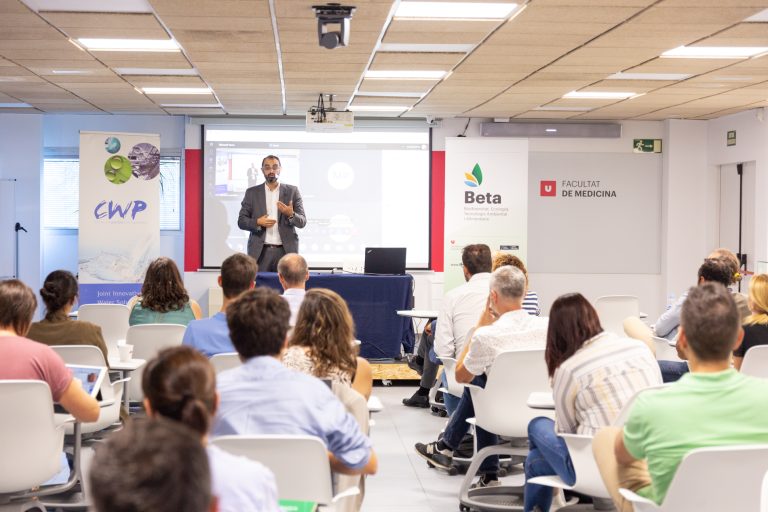
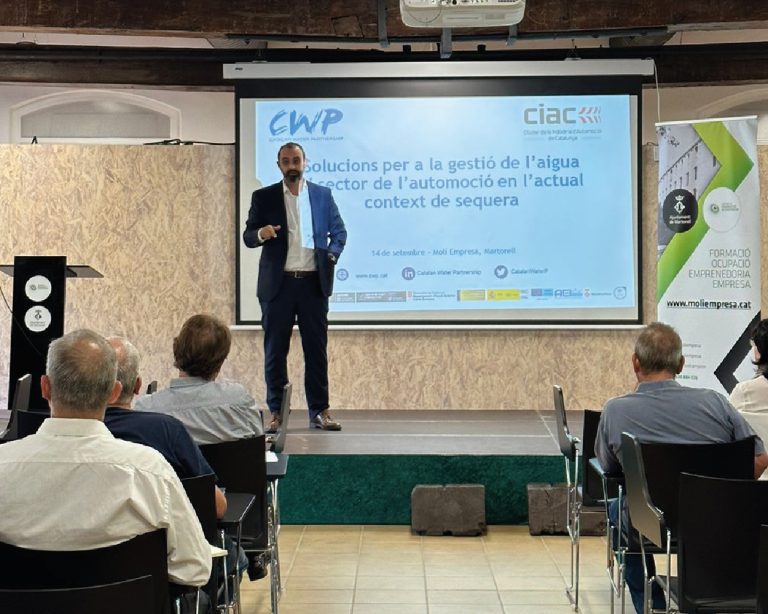
On October 23rd, the Catalan Water Partnership organised the “EDAR Industrial 360” conference, focused on the challenges of Industrial Wastewater Treatment Plants (EDARi) within the new regulatory framework resulting from the upcoming transposition of the European Directive on urban wastewater treatment. The event emphasised the potential of reclaimed water reuse, the removal of emerging pollutants, and digitalisation, with the participation of several industry professionals.
The session opened with a first block of presentations by representatives from the Catalan and Spanish governments. Representing the Catalan Water Agency (ACA), Antoni Munné, Head of the Environmental Management Area, spoke about the implementation of the new regulatory changes and their effects on industry. In his presentation, Munné outlined the main priority substances responsible for the failure to meet the chemical status of water bodies in Catalonia.
The Spanish Ministry for the Ecological Transition and the Demographic Challenge (MITECO) also participated with two presentations. Alejandra Puig, Deputy Director General for Water Planning, explained the new regulations on emerging pollutants and their effects on the status of receiving waters. Then, Irene Morante, Head of the Sanitation and Wastewater Treatment Area at the Directorate General for Water, discussed the requirements for industrial discharges under the new urban wastewater treatment directive and the producer’s responsibility.
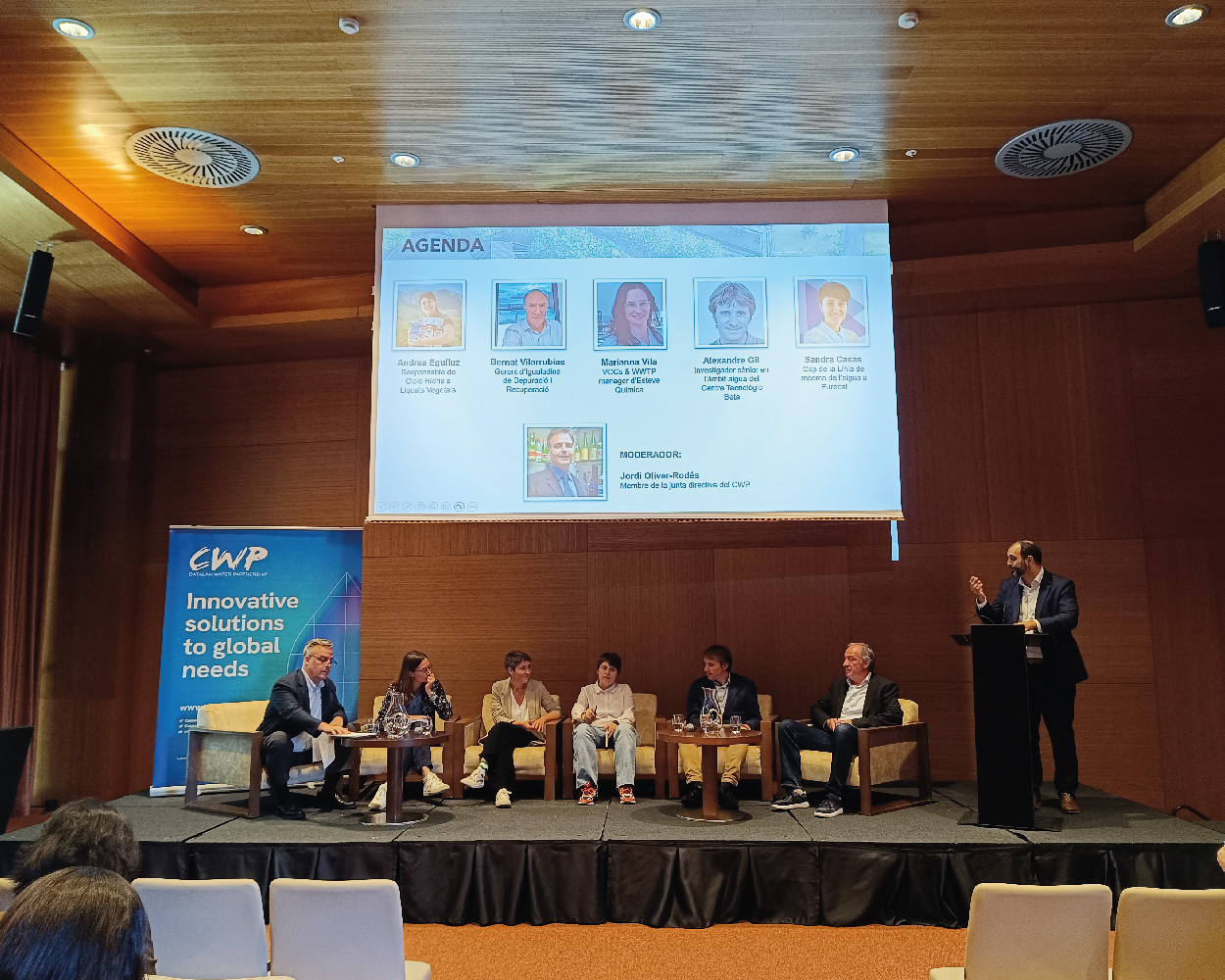
The second block featured a roundtable entitled “Challenges in Wastewater Treatment and Reuse”, moderated by Jordi Oliver-Rodés, board member of the CWP. It brought together representatives from various industrial sectors and leading research centres. Representing the beverage sector was Andrea Eguíluz, Water Cycle Manager at Liquats Vegetals; representing the textile sector, Bernat Vilarrubias, Manager of Igualadina de Depuració i Recuperació; and from the chemical sector, Marianna Vila, VOC & WWTP Manager at Esteve Química. The research perspective was provided by Alexandre Galí, senior water researcher at the BETA Technological Centre, and Sandra Casas, Head of the Water Research Line at Eurecat. The roundtable highlighted innovative projects for the reuse of reclaimed water from industrial WWTPs, which are especially relevant in the current context of drought in Catalonia, and shared sector-specific challenges for achieving sustainable and efficient industrial wastewater management.
The third and final block included a series of presentations of innovative solutions and technologies to improve EDARi management. Xavier Cardoso, Country Manager at Ecolab, spoke about water circularity and sustainable growth. Erena Estrada, Director of Industry and Innovation at Remondis Iberia, discussed the challenge of achieving zero discharge in industry. Raquel García, CEO of Ecomemb, presented the use of reverse osmosis ecomembranes in wastewater treatment. Oriol Ginés, Business & Digitalization Manager at SPIN, spoke about the integration of digitalisation into industrial WWTPs and its advantages. Finally, Xavier Cantarero, Business Developer at HACH, presented digital technologies to ensure compliance with discharge limits.
With over 110 attendees, the conference served to present the latest updates on the new regulatory framework and the challenges associated with wastewater treatment and management in various industrial sectors. It also showcased innovative solutions and technologies for improving EDARi management. In addition, the networking space encouraged exchanges between professionals, fostered the creation of synergies and collaborations, and offered a platform to debate the topics covered during the session.
This conference is part of the actions that the cluster will carry out annually, as an event focused on water resource users. It stems from the activities of the CWP’s water users working group, aimed at promoting conferences, activities, and projects in cooperation with industrial companies working to achieve the most sustainable water management possible.