The Catalan Water Partnership promotes innovation in nature-based solutions at the ecoSTP 2025 congress
From 23 to 26 June, the international congress on EcoTechnologies for Wastewater Treatment (ecoSTP 2025) took place in Stockholm, organized by the International Water Association and the KTH Royal Institute of Technology. This seventh edition of the congress brought together experts from around the world with the aim of bringing together the academic and technological fields in order to share knowledge and advances in the field of municipal and industrial wastewater treatment, including water, energy and materials recovery, sustainability, wastewater epidemiology and decision-making mechanisms in water governance.
In this context, a workshop organized by the Catalan Water Partnership was held on June 25, focused on nature-based solutions (NBS) under the title “Advancing nature-based solutions for wastewater treatment and urban water management: perspectives, challenges and practical experience”. Moderated by Víctor Matamoros (IDAEA-CSIC), the workshop hosted the presentation of several leading European projects in this field: BIODAPH2O, by Victòria Salvadó (University of Girona); UPWATER, presented by Víctor Matamoros himself; LIFE4ZOO, with Ignasi Rodríguez-Roda (LEQUIA); GREENHOOD, presented by Paula Carrera (BETA Technological Center); CARDIMED, presented by Costas Noutsopoulos (NTUA); and MULTISOURCE, by Fabio Masi (IRIDRA).
Despite addressing different contexts and approaches, the projects showed a clear thematic alignment and remarkable synergies. For example, both BIODAPH2O and CARDIMED are born from the experience and learnings of the HYDROUSA project, with which they share a demonstration site, while the achievements of the INNOQUA project have guided some activities of GREENHOOD and BIODAPH2O. These connections highlight the importance of knowledge transfer and collaboration between research centres and companies for the development of sustainable and effective solutions that take advantage of the potential offered by nature in urban wastewater treatment.
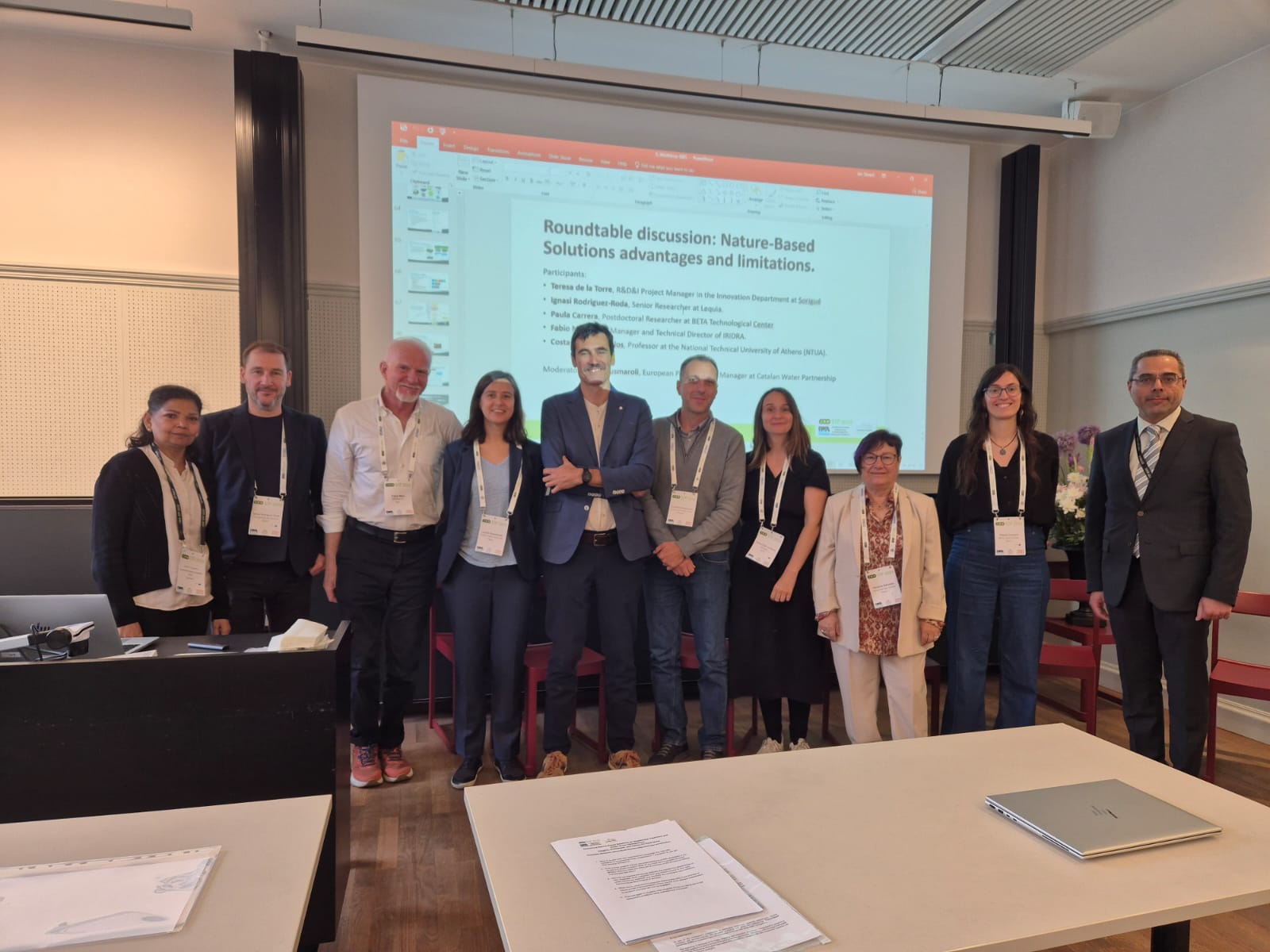
After the presentations, a round table moderated by Lucia Gusmaroli (Catalan Water Partnership), in which Teresa de la Torre (Sorigué), Ignasi Rodríguez-Roda (LEQUIA), Paula Carrera (BETA Technology Center), Fabio Masi (IRIDRA) and Costas Noutsopoulos (NTUA). During the debate, reflection was given on the advantages and limitations of nature-based solutions, the degree of market readiness to adopt these technologies, and the need for improvement in the evaluation and monitoring of their effectiveness, especially in changing environments and with regulatory restrictions.
Within the framework of the workshop, two projects with the direct participation of the Catalan Water Partnership should be particularly highlighted. On the one hand, GREENHOOD, coordinated by the BETA Technology Centre, which aims to develop and deploy regional strategies for nutrient management in water, soil and air in Europe and which, in the Catalan pilot, is testing a hybrid natural system to improve tertiary wastewater treatment, showing high efficacy in reducing nutrients and antibiotic resistance genes in small-scale wastewater treatment plants. On the other hand, LIFE BIODAPH2O, led by the University of Girona, which aims to demonstrate the efficiency of BIODAPH technology, a tertiary wastewater treatment based on nature, compact and low energy consumption, based on the purification capacity of biological organisms such as water fleas (Daphnia magna) and microalgae-bacterial biofilms. This technology has been implemented in the Quart WWTP (Girona, Spain) and the Antissa WWTP (Lesbos Island, Greece) with the aim of reducing pollutant discharges (such as nutrients, emerging pollutants, pathogens and microplastics) into freshwater ecosystems, while providing high-quality reclaimed water for agricultural irrigation.
A session to highlight the importance of NBS in the future of wastewater treatment and urban water management
The session highlighted the growing international interest in nature-based solutions as a viable, efficient and sustainable alternative to face the challenges of wastewater treatment and integrated management of the water cycle. The experiences shared during the workshop underlined both the transformative potential of these solutions to achieve environmental objectives and adaptation to climate change, as well as the need to continue advancing in their validation, integration into public policies and social acceptance.
The active participation of the Catalan Water Partnership in this space reinforces its commitment to collaborative innovation, knowledge transfer and the promotion of nature-based solutions within the water sector. In addition, it contributes to positioning Catalan entities as European benchmarks in the research and implementation of natural technologies that allow them to face the current and future challenges of water management with a sustainable and transformative perspective.